
Finding the right Quran teacher online can feel overwhelming. There are many academies and tutors to choose from, and every website promises the same thing. For parents in the UK, USA, Canada and Australia, there is an extra challenge: classes must fit around school, work and different time zones.
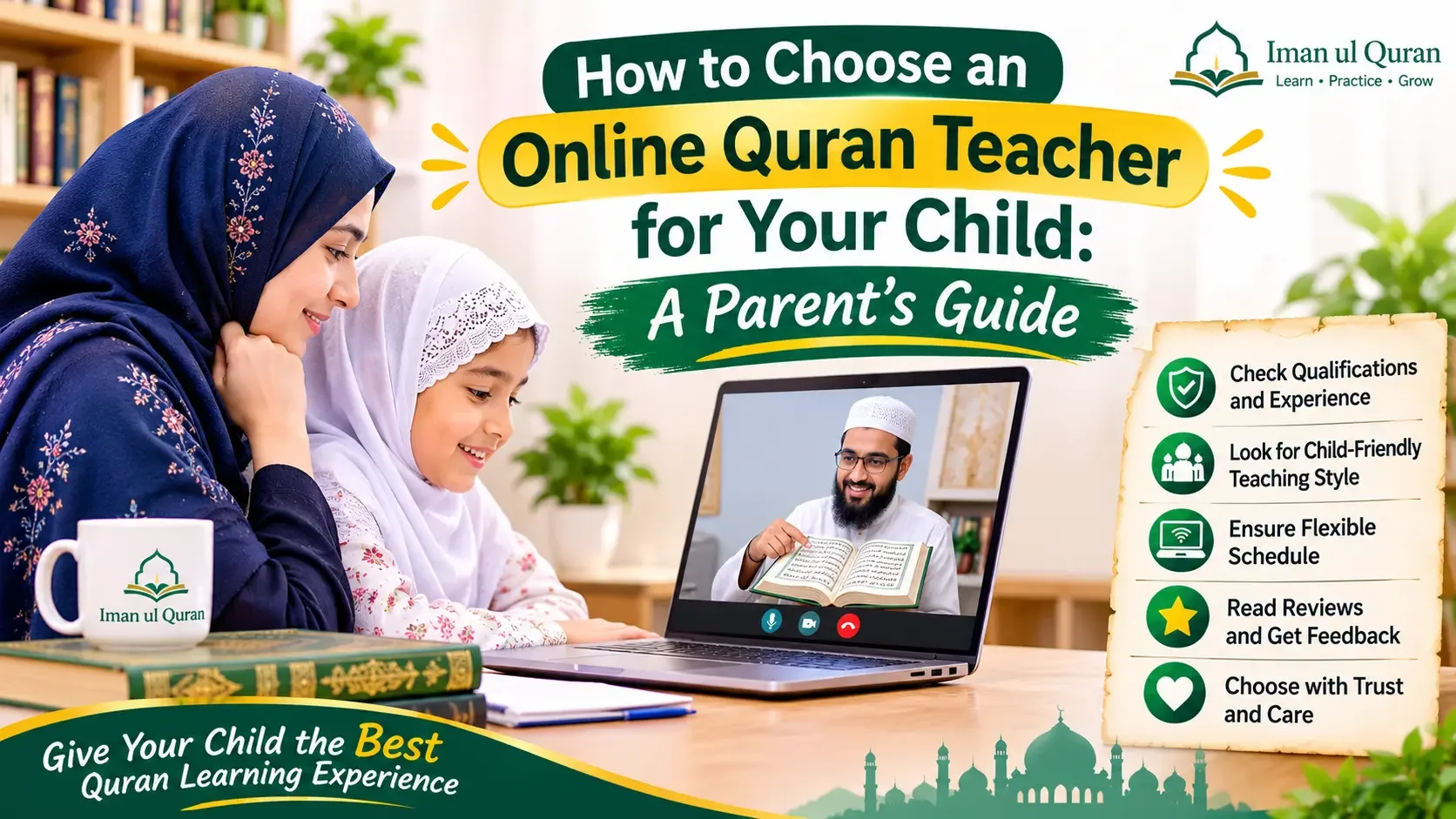
This guide gives you a simple checklist for choosing an online Quran teacher for your child, the questions to ask before you pay, and the warning signs to watch for.
خَيْرُكُمْ مَنْ تَعَلَّمَ الْقُرْآنَ وَعَلَّمَهُ
"The best among you are those who learn the Quran and teach it." (Sahih al-Bukhari 5027)
1. Choose one-to-one lessons over group classes
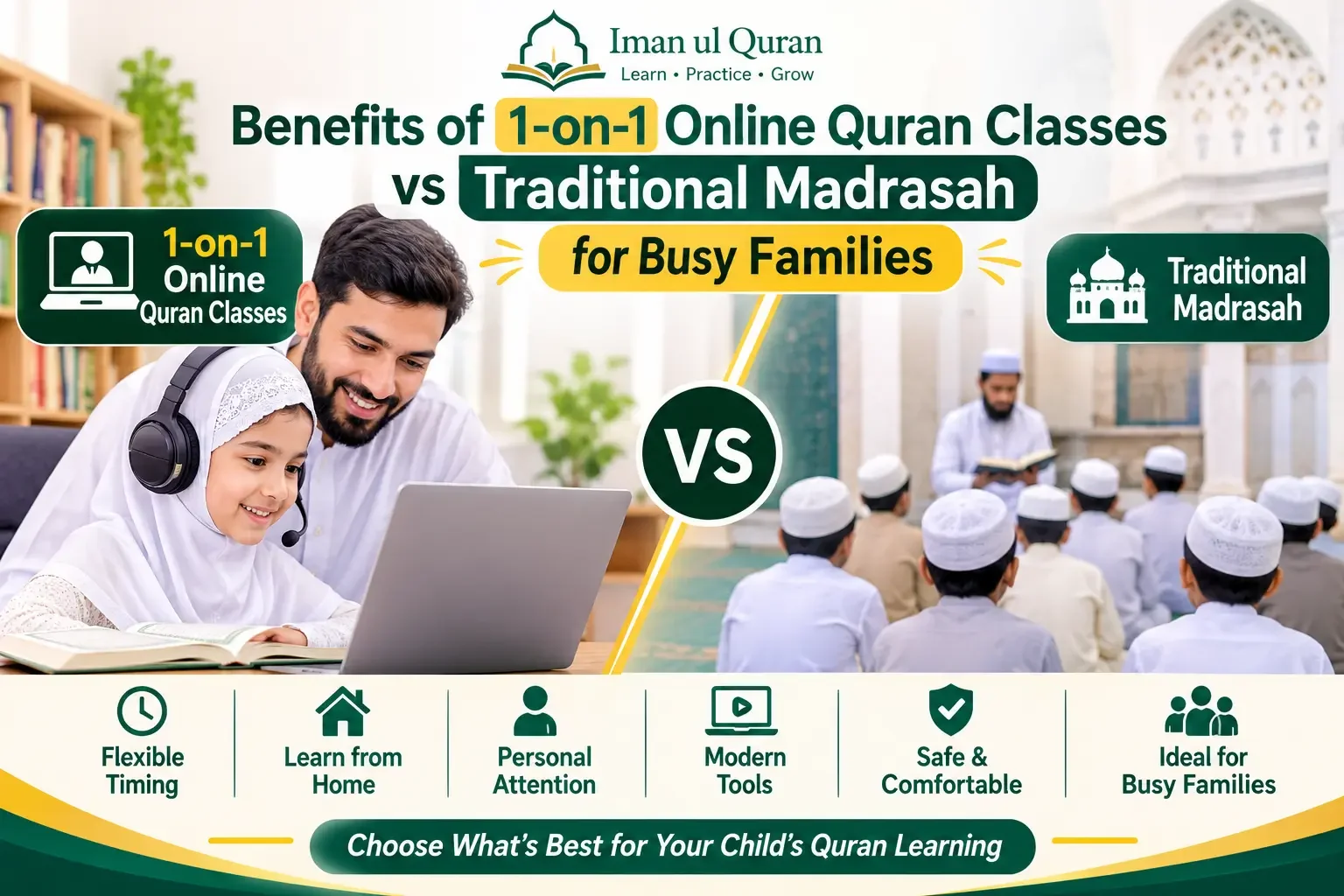
Children learn the Quran best when the teacher can hear every letter they say. In a group class, a teacher may only listen to your child for a minute or two. In a one-to-one lesson, the whole session is focused on your child, so mistakes in pronunciation (Makharij) are corrected straight away and the pace matches your child, not the class.
If your child is a beginner or is shy, one-to-one lessons are especially helpful, because they can ask questions without feeling embarrassed.
2. Check the teacher's training and recitation
A good Quran teacher should be able to explain what they studied and where. Ask:
- Did they learn Tajweed from a qualified teacher, and can they recite for you in a short test?
- Have they taught children, adults or both?
- Do they have experience teaching students who live in non-Muslim countries?
Do not rely only on a profile page. A short trial lesson is the best way to hear for yourself how a teacher recites and explains.
3. Ask for a free trial before you commit
A trial class lets you and your child meet the teacher with no pressure. During the trial, watch for these things:
- Is the teacher patient and kind with your child?
- Does your child understand the instructions?
- Is the sound and video clear, and does the lesson start on time?
- Does the teacher test your child's level and suggest a clear plan?
You can book a free trial class with Iman ul Quran and see how a lesson works before you decide.
4. Make sure the lesson times suit your time zone
Families in the UK, USA, Canada and Australia are often hours away from where the teacher lives. Before you start, agree on:
- The days and the time of each class, written in your own time zone.
- How many days per week your child will study (for many children, 3 days a week works well; 5 days a week is common for Hifz).
- What happens if a class is missed, and how a make-up lesson is arranged.
5. Match the course to your child's level
Your child's starting point decides what they should study first:
- Cannot read Arabic letters yet: begin with Noorani Qaida, which teaches letters, sounds and joining letters step by step.
- Can read slowly: continue with Quran reading (Nazra) to build confidence and speed.
- Reads fluently: add Tajweed so that every letter is pronounced correctly.
- Wants to memorise: a Hifz programme with daily revision works best.
See all the Quran courses for kids, sisters and adults to find the right starting point. For young children there is also a dedicated Quran classes for kids course.
6. Choose a male or female teacher that your family is comfortable with
Many families prefer a female teacher for daughters and sisters, and some prefer a male teacher for older boys. A good academy lets you choose. At Iman ul Quran you can request a male or female teacher when you book your trial, and you can meet the team on the teachers page.
7. Put your child's safety first
Online lessons take place in your home, so safeguarding matters. A responsible academy should:
- Explain how sessions are supervised, and whether parents can sit in.
- Tell you clearly if lessons are recorded, and only record with parental permission.
- Keep communication between teacher and child inside the lesson, with parents as the contact for everything else.
Read how we handle this in our child safeguarding policy.
8. Look for clear progress reports
You should always know where your child is. Ask how progress is shared: for example, a short message after lessons, a monthly update, and clear goals such as "finish Noorani Qaida" or "complete Surah al-Mulk with Tajweed".
9. Be clear on fees and cancellation
Before you start, make sure the price, billing date and cancellation terms are written down. Beware of academies that ask for a long payment upfront before you have even had a trial. You can view the tuition plans and fees and our refund and cancellation terms on this website.
Warning signs to avoid
- No trial lesson, or pressure to pay immediately.
- A teacher who cannot recite for you or explain their background.
- Large groups described as "personal classes".
- No clear policy on safeguarding, recordings or missed classes.
- Promises like "finish the Quran in a few weeks". Real progress takes steady practice.
Quick checklist
- One-to-one lessons.
- Qualified teacher you have heard recite.
- Free trial lesson first.
- Lesson times that suit your time zone.
- A course that matches your child's level.
- A male or female teacher you are comfortable with.
- Safeguarding rules you can read.
- Regular progress updates.
- Clear fees and cancellation terms.
Ready to start?
If you would like to see what a lesson is like, book a free 3-day trial with Iman ul Quran, or send us a message on the contact page. We will help you choose the right course and teacher for your child.
Quran Classes for Kids
Practice these recitation rules and lessons directly 1-to-1 with our certified male and female Quran instructors.